
Web Performance & Frameworks
Building P1 on Cloudflare: AI-native web composition and governance

Chris Yates
Pantheon
Open source maintainers are burning out under the volume of AI-generated issues and PRs. The Astro team built an automated triage pipeline using isolated AI subagents running inside GitHub Actions. The system reads incoming bug reports, reproduces them in sandboxes, diagnoses root causes, and ships preview releases for reporters to verify. The result: open issues dropped from more than 200 to about 30 — heading toward 0 for the first time in the project's more than 5-year history. This talk covers the architecture behind the pipeline, the state machine driven by issue labels, how we decoupled the logic into a reusable GitHub Action, and the broader lessons about using agent automation to free maintainers to focus on the framework instead of the backlog.
0:03Thanks everybody for coming. My name is Matthew Phillips and I'm one of the co-creators of Astro. I'm here to talk to you. Well, first off, quick poll. How many people here know about Astro or have used Astro? Okay, great. I'm glad I don't have to explain that. What about software factories? How many people know about what a software factory is? Cool. Show of hands, who's building a software factory? oh my gosh all right this might be novice for some of you all but um i'm gonna i'm gonna give it anyways um so yeah i'm co -creator of astro but like i said i'm not here to talk to you about astro today or features or like performance improvements or anything like that we're doing all that stuff but that's not what this is about uh instead i want to talk about like something else that we're doing obviously software factory but related to issues so you know if you follow like open source what's going on a lot of maintainers are experiencing burnout from like this influx of issues that are coming in a wave of ai right you've probably heard that some projects are like turning off their pull requests or turning off their issues so i want to give a perspective on another way to do it all right so astro has been around since 2021 so five years you can probably see from this chart here this is kind of a chart of open issues that we've had over the over the five years there's all these peaks and valleys happening right um so i actually if you if you look at the first like halfway a little bit over halfway through 2021 that was
1:33when we first started the project i mean obviously like we're focused on like building astro itself building out you know everything that it does uh so we weren't focused on the issues uh so at one point we get to over 200 and we're like oh my gosh we need to do something here um so i like i personally took like two or three months where i just do nothing but work on issues i feel i feel pretty bad we're pretty proud about that actually that got down to under 100 in that amount of time doing it the hard way you know but anyways you kind of see these peaks of valleys you know as you're working on a project you're working on features you're working on a big release you're not work you're not doing issues and then maybe like after the release you focus more on stability etc you get the issues down for a long time we had like this magic number of 100 that like we felt good if we were like at 100 but as you can see that didn't really last very long and eventually like if you did like you know if you if you charted this out like it is going up right like over time it is going up and then we had a peak 250 and then april 2026 is when we started working on our software factory and you kind of see what happened after that but yeah let's focus on what's changed recently like especially in the last year and it's like not a surprise anyone that that ai is what happened ai really changed the algebra for how issues get reported the traditional way the traditional reports were happening you know someone manually sitting down and filing an issue if you've ever filed an issue for an open source project you probably know that
3:05they do things like ask for a reproduction which means you have to you know you don't just hand them your app and be like hey there's a bug in here people will get very annoyed by that instead they'll ask you to create a minimal reproduction which means like you know take for astro for example create a very basic astro app that like shows the bug then you have to you know write the report you have to explain what happens what you expect to happen so it's a lot of work right like most people are not going to go through that effort and i've always appreciated people who do file good bug reports because it is so much work um so that what this really means is that the pool of people who are going to file bug reports is relatively small and what this also means is that like how many issues you have is relative to how you know how popular your project is like a small project not not so many issues not too bad a giant project like typescript like you know it's out of control but what changes in when agents started appearing is that it became very simple to file an issue instead of like you having to spend all this time doing it yourself you just said to the agent hey go file an issue for me it would do it in few minutes and you're done.
4:12So we want to do something about this. We didn't want to like cut corners. We didn't want to do the thing where we, you know, some people, you know, like I said before, close pull requests, close, close issues. We didn't want to do that. We didn't want to do like stale bots, which is like a technique for having a bot that will close issues that are older than, you know, a few months or something like that. We didn't want to declare issue bankruptcy, which is something projects do with AC. just stop caring about the backlog of issues. So essentially, like we wanted to use AI to fight AI, right? Like use the tool against itself. Yeah, we really wanted to keep trying to triage things just carefully as we have always done. So this is what we ended up with, and I'll go through the steps of how we got there, but we have an agent skill, which is what allows us to run through the triage locally.
5:08started there right like if you've ever built a skill but well actually well i'll explain in the next slide what a skill is but yeah we had something to run locally and then we turned that into an automation it was a github app which is runs in your github ci and eventually we got our factory which is a cloudflare worker which is how everything works today
5:28so let's talk about the skill itself like what it does so this is you know it's a specific specific to an open source project but it's you know maybe applicable to know, an app that you build yourself. Like I said, it did start, it all started as an agent skill, which, you know, if you use Claude, it's the slash commands that you can trigger. A skill is essentially just a prompt. It's a markdown file with a long prompt. It often like goes through a series of steps. So having this skill that we can run locally means that we are able to iterate on it faster. We are able to do things like, you know, as the automation ran into errors. we could like run the triage locally, see what the error was, improve the whole system.
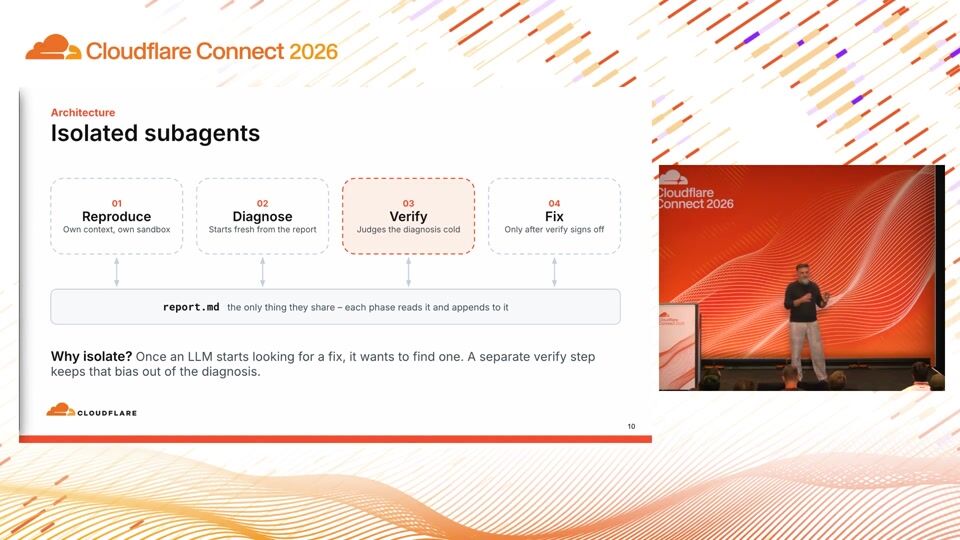
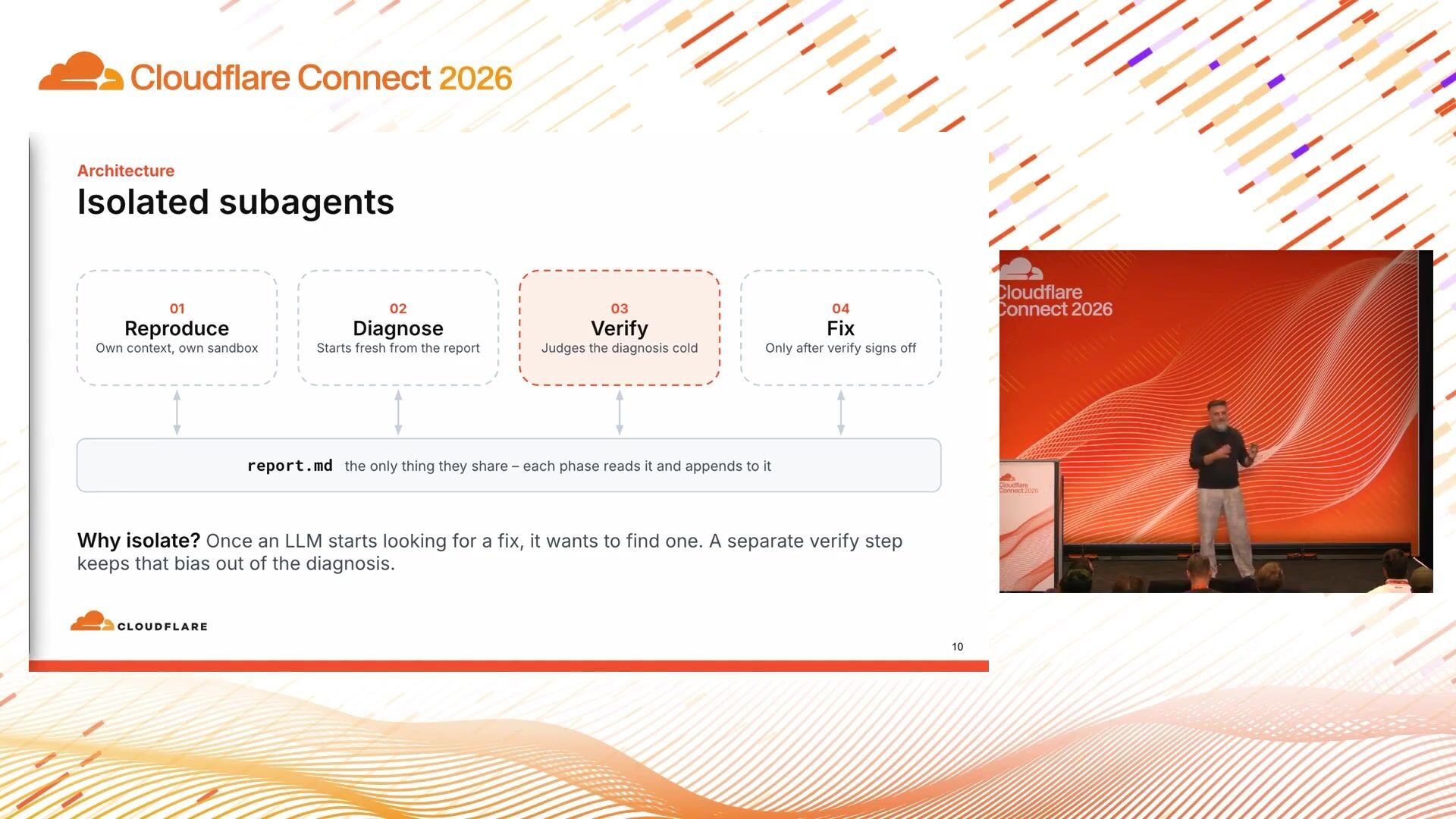
6:12All right, so here's the skill itself. We broke it into four distinct steps. First, you need to reproduce the issue, which means like, you know, if the bug report has reproduction, you pull that down, start up the dev server, see what happens, see, you know, basically you're confirming what the report says. Then you need to diagnose it, which, you know, it means instrumenting your code. adding console.logs for example that that triggers you know where it actually happens in the code that triggers the issue next step you need to verify and this is a pretty important one just because someone files an issue doesn't mean that it actually is a bug right like things might be working that way on purpose so to verify you need to like check the documentation check the test these are all indicators of whether this this behavior is is on purpose or not and finally the which is i think pretty obvious like write a test you know fix the fix the bug uh and then push it all right so remember we started this back in like march april i don't know if you're using ai back then but like it wasn't nearly as good as it is today even though like at the time we thought it was magic as well um so what we did to like at the time especially models had this tendency to like want to go through the entire thing they have kind of a bias built in uh So we ran each step as an isolated sub-agent.
7:32So like reproduction ran by itself, then diagnostic. They all shared state through like a report.md. So when reproduction ran, it would write to this report, then the next step, the next step. That way we need to like verify that there's no bias to continue. It's just focus only on doing the verification part.
7:51So as our confidence in the skill improved, we're able to focus more on the automation. So we wanna go beyond. triage like at this point we have we're able to triage an issue which basically just means like you know find hopefully find a fix report the findings back to the user in the issue so like how can we take it further so what we have is a state machine um so i don't know if you ever built state machines before but basically a state machine means that well a finite state machine i should say means that you can only be in one particular state at a time so you start off in needs triage when the issue gets created then you go to in progress as the the bot is working and then finally fix pending and we ask the user to test it out the user might report back that it didn't work and they hopefully explain why that goes back into the system the triage can run again now it has more context it knows what the user just told us and hopefully it can fix it correctly the next time eventually hopefully the user verifies the fix and then you get a pull request so this is kind of the happy path I kind of explained this already the only part I didn't explain is step three which is the preview release so preview release basically means like with with npm there's a service that allows you to create an npm package for just that change so this lets the user install that package and test it like in the real application so that's how we confirm that it actually works then a pr is open we've actually gone further than than this now we have a review agent that runs on the pr it reviews the code you know make it's correct it will report its findings back it might ask for changes if it asks for changes
9:26there's another bot that runs on that the author bot the author bot is going to run look at the changes um it doesn't always accept what the review bot says that's pretty key right but yeah there's this talking back and forth that happens until eventually you know the review agent runs again and then hopefully you know it approves the change so when human comes around to review this it's already gone through several layers
9:51uh okay now go oh there we go okay this is what it looks like if you're the reporter um you see this comment that gets added it says that the triage completed it tells you you know the level of confidence in it you can see the full report if you want to um there's a priority label that's added this is mostly for the maintainers to know like is this you know is this something i should stop what i'm doing and go and go uh review this and then yeah there's the mtm install command. The actual architecture here is that, like I said, we graduated to making this based off Cloud4Workers. It's a GitHub app. This is an app that you register with GitHub. You tell it what events you want to listen to. It sends it to your webhook, which is our worker. Our worker is going to route that to the correct skill because we have several skills going on now. I mentioned PR reviews, triage. We call those capabilities.
10:41For triage, out everything runs inside of a durable object it runs it runs the work it kind of acts as a coordinator it runs the workflow so this is another view of kind of the same idea we have events coming from github these are all we don't actually have discord or slack or anything but you can imagine that you know you can send other type of events into this system you have various capabilities triage is the main one i'm talking about here a pr review we have the experiment with like kind of an adversarial type review We have security triage as well because security reports get reported somewhere else in GitHub. And we have kind of a special skill to triage those, but that's very important as well. And there's a couple more I'm not even thinking of, but you can kind of see how you're able to route everything to different skills depending on what's happening.
11:31All right, so what would actually change for maintainers? First off, like a big fear that everybody had on the team and myself included is that doing it this way would make it feel impersonal, right? this bot posting a comment um a lot of people said that they like helping people and they were worried that this would take that away but i think what happened actually is that you know people don't actually like fixing bugs like most people don't like fixing bugs i kind of like fixing bugs but most people don't actually like doing that um so even though people would try to help obviously like now they're able to help in a different place in discord support we have you know rfc discussions is where we discuss like feature changes to add or just like working with contributors you know people who are trying to contribute to the project uh one one oh yes okay this is right uh one one thing to like always keep in mind if you try this for yourself you might run into issues and i've seen a lot of people do this where the the fix that the agent comes up with is like kind of low quality or like it's not what you want right and a lot of times it's very easy to kind of dismiss the process and just feel like well this doesn't work I'm not going to keep doing this, but I think you should treat any failure as a signal in your code base.
12:44So what I mean, like your abstractions might be opaque or there's not enough test coverage, right? Missing documentation, all these things contribute to the success of the agent. And I'll give one example here. There's these HMR bugs that kept coming up. HMR stands for hot module replacement, which is a feature of VEAT. Essentially, when you're running a dev server you can edit your code and like it will reload that code without restarting your dev server but there was this one particular bug that kept happening not the same bug actually but these different hmr bugs and they kept wanting to change this like if condition the same if condition every time and we knew it was it fixed the bug that the agent was working on but it wasn't correct right it broke other things um so we didn't we didn't accept that we didn't do it that way and then after about the third or fourth time i realized that like there was wrong with this if condition and so all i did was add a comment above it and explained why the logic of it right and then once i did that the agent never tried that fix again like right like it kind of it understood um and not only did not try bad fixes now now it's actually getting to the root cause of the particular issue so like it's in this way that you improve the code which results in you know the system working better itself did i go too far No, I didn't.
14:04Let's talk a little bit about like, where is this going? So like, you know, I've kind of explained how, what we've built up until now, we are able to get up to a PR that's pretty much ready. But, you know, I think there's more, right? One thing I've actually noticed that I didn't really mention here, you know, we have this whole flow where the reporter verifies the fix. One thing I've noticed recently is that a lot of people don't actually do that. And so I don't. I mean, I don't really know why, but my assumption is that, you know, people are having their agents file an issue. They go about their day. They find a workaround. They're not looking at this issue anymore, so they're not actually, you know, trying it out. So we need to fix that somehow. But, yeah, everything from here for us is just some ideas that I have. You know, some of you, it sounds like you're already doing these sorts of things.
14:50But, yeah, so auto-merging is one. Like, there's been a lot of talk recently about this. There was an article just the other day by Will Larson. I encourage you to read that. The idea is that you can rate a pull request to say it's low risk. And if you can rate it to say it's low risk, then maybe you can just go in and auto-merge that. What would be low risk? It'd be something that your PR review has gone through and not found any high severity issues. Or maybe it's from a maintainer. Maybe it's a small diff. It's not changing that many files. Or, you know, maybe... There's it's not touching like a security sensitive part of the code base things like that you can kind of define your own rules But I think this is important because you know Still having a human for these small change in when you all we're really doing is looking at the code and just making sure nothing Weird is happening which hopefully the all the reviews have already caught can be a waste of time
15:47Here's another idea so like right now we just have github as the only input I talked about that but like things happen in Astro outside of just GitHub. I would love it if we have Discord and people ask support questions. Like sometimes those support questions are actually bugs. And it turns out, you know, we always say, hey, could you go file a bug report? But like, what if we made that easy? What if the user could just write like slash report or something that turns into a GitHub issue, which feeds into the factory. So you get this nice flow of fixes. And you can imagine the same thing for like, oh, this is the documentation is not very clear. Let's like. improve the docs or start an rfc discussion if the if the person's asking for a new feature
16:31meetings is a big thing i was talking about with someone here about that um so like i i don't like meetings i don't know about you all but meetings aren't great but like meetings are one of the quickest ways to reach consensus with with teammates so and we we do them right so you do a meeting maybe you're talking about a new feature that you want to implement something like that and then what happens a day you leave the meeting you go do something else like it's a few days a few weeks before you get back to actually implementing that thing and by the time you do you've kind of forgotten what you've talked about you've forgotten what the consensus even was so like why even do that like maybe we can just do have a meeting there's already software that will create transcripts from that let's feed that into our factory we have a skill for meetings that's able to extract okay i'll go this is about a feature request let me go ahead and draft a pull request for that just no idea this is kind of a silly one i sometimes get emails from people even today about like bugs people report will email my personal email with bug reports about astro like it'd be great if i could just forward those over to the factory some email address and let it take care of it um memory is a big thing like i think one place we're leading is like we really want a central agent that knows everything about our projects.
17:46So, you know, if you can imagine you're feeding Discord, you're feeding all these different channels to the same bot, it's going to have a lot of, if you're saving memory correctly, it's going to have a lot of context and history. I'd love to be able to attach to my factory and like ask it questions like, why did you fix it this way? Or why did you implement this thing? And it can tell me, oh, because there was an RSC discussion and it said that it should work this way, right? That's just another kind of thing I'm thinking about.
18:16all right so we went from 250 we got down to zero but like as i said it's not really over the factory like keeps improving but i mean i one one goal i want to get away from i want to people to take away is like i do think there's a future for for not every project for a lot of projects where most of our work is not happening like at a prompt you're not working you're not sitting at clod code or whatever like that's not where your work actually happened your work just happens naturally as you're discussing with your teammates and then the factory is what actually implements those things all right try it yourself flu i didn't really mention flu too much but our factory is built on top of flu which is an ingenic framework it can do all sorts of cool things that are not you know they go beyond just get up issues but this is our factory itself like it's open source you wouldn't want to install this yourself it's very much tuned to astro but tell your agent hey i want you to make make me a version of this thing for for my project.
19:12And that's it, thanks everybody.
Chris Yates
Pantheon
Tanner Linsley
TanStack
Alexander Braunreuther, Mark Dembo
Contentful · Cloudflare
Be the first to know when registration opens and the agenda goes live.
---
title: "Building a software factory: Driving Astro's Issues to zero"
url: "https://www.cloudflare.com/connect/2026/session/building-a-software-factory-driving-astros-issues-to-zero"
year: 2026
---

# Building a software factory: Driving Astro's Issues to zero

[Watch session](https://www.cloudflare.com/connect/2026/session/building-a-software-factory-driving-astros-issues-to-zero)

## Session details

- **Track:** Web Performance & Frameworks
- **Topics:** Programmable Platforms, AI transformation
- **Solution areas:** Developer Platform

## About this session

Open source maintainers are burning out under the volume of AI-generated issues and PRs. The Astro team built an automated triage pipeline using isolated AI subagents running inside GitHub Actions. The system reads incoming bug reports, reproduces them in sandboxes, diagnoses root causes, and ships preview releases for reporters to verify. The result: open issues dropped from more than 200 to about 30 — heading toward 0 for the first time in the project's more than 5-year history. This talk covers the architecture behind the pipeline, the state machine driven by issue labels, how we decoupled the logic into a reusable GitHub Action, and the broader lessons about using agent automation to free maintainers to focus on the framework instead of the backlog.

## Speakers

- [Matthew Phillips](https://www.cloudflare.com/connect/speakers/2405304) — Principal Systems Engineer, Cloudflare

## Transcript

[0:03] Thanks everybody for coming. My name is Matthew Phillips and I'm one of the co-creators of Astro. I'm here to talk to you. Well, first off, quick poll. How many people here know about Astro or have used Astro? Okay, great. I'm glad I don't have to explain that. What about software factories? How many people know about what a software factory is? Cool. Show of hands, who's building a software factory? oh my gosh all right this might be novice for some of you all but um i'm gonna i'm gonna give it anyways um so yeah i'm co -creator of astro but like i said i'm not here to talk to you about astro today or features or like performance improvements or anything like that we're doing all that stuff but that's not what this is about uh instead i want to talk about like something else that we're doing obviously software factory but related to issues so you know if you follow like open source what's going on a lot of maintainers are experiencing burnout from like this influx of issues that are coming in a wave of ai right you've probably heard that some projects are like turning off their pull requests or turning off their issues so i want to give a perspective on another way to do it all right so astro has been around since 2021 so five years you can probably see from this chart here this is kind of a chart of open issues that we've had over the over the five years there's all these peaks and valleys happening right um so i actually if you if you look at the first like halfway a little bit over halfway through 2021 that was

[1:33] when we first started the project i mean obviously like we're focused on like building astro itself building out you know everything that it does uh so we weren't focused on the issues uh so at one point we get to over 200 and we're like oh my gosh we need to do something here um so i like i personally took like two or three months where i just do nothing but work on issues i feel i feel pretty bad we're pretty proud about that actually that got down to under 100 in that amount of time doing it the hard way you know but anyways you kind of see these peaks of valleys you know as you're working on a project you're working on features you're working on a big release you're not work you're not doing issues and then maybe like after the release you focus more on stability etc you get the issues down for a long time we had like this magic number of 100 that like we felt good if we were like at 100 but as you can see that didn't really last very long and eventually like if you did like you know if you if you charted this out like it is going up right like over time it is going up and then we had a peak 250 and then april 2026 is when we started working on our software factory and you kind of see what happened after that but yeah let's focus on what's changed recently like especially in the last year and it's like not a surprise anyone that that ai is what happened ai really changed the algebra for how issues get reported the traditional way the traditional reports were happening you know someone manually sitting down and filing an issue if you've ever filed an issue for an open source project you probably know that

[3:05] they do things like ask for a reproduction which means you have to you know you don't just hand them your app and be like hey there's a bug in here people will get very annoyed by that instead they'll ask you to create a minimal reproduction which means like you know take for astro for example create a very basic astro app that like shows the bug then you have to you know write the report you have to explain what happens what you expect to happen so it's a lot of work right like most people are not going to go through that effort and i've always appreciated people who do file good bug reports because it is so much work um so that what this really means is that the pool of people who are going to file bug reports is relatively small and what this also means is that like how many issues you have is relative to how you know how popular your project is like a small project not not so many issues not too bad a giant project like typescript like you know it's out of control but what changes in when agents started appearing is that it became very simple to file an issue instead of like you having to spend all this time doing it yourself you just said to the agent hey go file an issue for me it would do it in few minutes and you're done.

[4:12] So we want to do something about this. We didn't want to like cut corners. We didn't want to do the thing where we, you know, some people, you know, like I said before, close pull requests, close, close issues. We didn't want to do that. We didn't want to do like stale bots, which is like a technique for having a bot that will close issues that are older than, you know, a few months or something like that. We didn't want to declare issue bankruptcy, which is something projects do with AC. just stop caring about the backlog of issues. So essentially, like we wanted to use AI to fight AI, right? Like use the tool against itself. Yeah, we really wanted to keep trying to triage things just carefully as we have always done. So this is what we ended up with, and I'll go through the steps of how we got there, but we have an agent skill, which is what allows us to run through the triage locally.

[5:08] started there right like if you've ever built a skill but well actually well i'll explain in the next slide what a skill is but yeah we had something to run locally and then we turned that into an automation it was a github app which is runs in your github ci and eventually we got our factory which is a cloudflare worker which is how everything works today

[5:28] so let's talk about the skill itself like what it does so this is you know it's a specific specific to an open source project but it's you know maybe applicable to know, an app that you build yourself. Like I said, it did start, it all started as an agent skill, which, you know, if you use Claude, it's the slash commands that you can trigger. A skill is essentially just a prompt. It's a markdown file with a long prompt. It often like goes through a series of steps. So having this skill that we can run locally means that we are able to iterate on it faster. We are able to do things like, you know, as the automation ran into errors. we could like run the triage locally, see what the error was, improve the whole system.

[6:12] All right, so here's the skill itself. We broke it into four distinct steps. First, you need to reproduce the issue, which means like, you know, if the bug report has reproduction, you pull that down, start up the dev server, see what happens, see, you know, basically you're confirming what the report says. Then you need to diagnose it, which, you know, it means instrumenting your code. adding console.logs for example that that triggers you know where it actually happens in the code that triggers the issue next step you need to verify and this is a pretty important one just because someone files an issue doesn't mean that it actually is a bug right like things might be working that way on purpose so to verify you need to like check the documentation check the test these are all indicators of whether this this behavior is is on purpose or not and finally the which is i think pretty obvious like write a test you know fix the fix the bug uh and then push it all right so remember we started this back in like march april i don't know if you're using ai back then but like it wasn't nearly as good as it is today even though like at the time we thought it was magic as well um so what we did to like at the time especially models had this tendency to like want to go through the entire thing they have kind of a bias built in uh So we ran each step as an isolated sub-agent.

[7:32] So like reproduction ran by itself, then diagnostic. They all shared state through like a report.md. So when reproduction ran, it would write to this report, then the next step, the next step. That way we need to like verify that there's no bias to continue. It's just focus only on doing the verification part.

[7:51] So as our confidence in the skill improved, we're able to focus more on the automation. So we wanna go beyond. triage like at this point we have we're able to triage an issue which basically just means like you know find hopefully find a fix report the findings back to the user in the issue so like how can we take it further so what we have is a state machine um so i don't know if you ever built state machines before but basically a state machine means that well a finite state machine i should say means that you can only be in one particular state at a time so you start off in needs triage when the issue gets created then you go to in progress as the the bot is working and then finally fix pending and we ask the user to test it out the user might report back that it didn't work and they hopefully explain why that goes back into the system the triage can run again now it has more context it knows what the user just told us and hopefully it can fix it correctly the next time eventually hopefully the user verifies the fix and then you get a pull request so this is kind of the happy path I kind of explained this already the only part I didn't explain is step three which is the preview release so preview release basically means like with with npm there's a service that allows you to create an npm package for just that change so this lets the user install that package and test it like in the real application so that's how we confirm that it actually works then a pr is open we've actually gone further than than this now we have a review agent that runs on the pr it reviews the code you know make it's correct it will report its findings back it might ask for changes if it asks for changes

[9:26] there's another bot that runs on that the author bot the author bot is going to run look at the changes um it doesn't always accept what the review bot says that's pretty key right but yeah there's this talking back and forth that happens until eventually you know the review agent runs again and then hopefully you know it approves the change so when human comes around to review this it's already gone through several layers

[9:51] uh okay now go oh there we go okay this is what it looks like if you're the reporter um you see this comment that gets added it says that the triage completed it tells you you know the level of confidence in it you can see the full report if you want to um there's a priority label that's added this is mostly for the maintainers to know like is this you know is this something i should stop what i'm doing and go and go uh review this and then yeah there's the mtm install command. The actual architecture here is that, like I said, we graduated to making this based off Cloud4Workers. It's a GitHub app. This is an app that you register with GitHub. You tell it what events you want to listen to. It sends it to your webhook, which is our worker. Our worker is going to route that to the correct skill because we have several skills going on now. I mentioned PR reviews, triage. We call those capabilities.

[10:41] For triage, out everything runs inside of a durable object it runs it runs the work it kind of acts as a coordinator it runs the workflow so this is another view of kind of the same idea we have events coming from github these are all we don't actually have discord or slack or anything but you can imagine that you know you can send other type of events into this system you have various capabilities triage is the main one i'm talking about here a pr review we have the experiment with like kind of an adversarial type review We have security triage as well because security reports get reported somewhere else in GitHub. And we have kind of a special skill to triage those, but that's very important as well. And there's a couple more I'm not even thinking of, but you can kind of see how you're able to route everything to different skills depending on what's happening.

[11:31] All right, so what would actually change for maintainers? First off, like a big fear that everybody had on the team and myself included is that doing it this way would make it feel impersonal, right? this bot posting a comment um a lot of people said that they like helping people and they were worried that this would take that away but i think what happened actually is that you know people don't actually like fixing bugs like most people don't like fixing bugs i kind of like fixing bugs but most people don't actually like doing that um so even though people would try to help obviously like now they're able to help in a different place in discord support we have you know rfc discussions is where we discuss like feature changes to add or just like working with contributors you know people who are trying to contribute to the project uh one one oh yes okay this is right uh one one thing to like always keep in mind if you try this for yourself you might run into issues and i've seen a lot of people do this where the the fix that the agent comes up with is like kind of low quality or like it's not what you want right and a lot of times it's very easy to kind of dismiss the process and just feel like well this doesn't work I'm not going to keep doing this, but I think you should treat any failure as a signal in your code base.

[12:44] So what I mean, like your abstractions might be opaque or there's not enough test coverage, right? Missing documentation, all these things contribute to the success of the agent. And I'll give one example here. There's these HMR bugs that kept coming up. HMR stands for hot module replacement, which is a feature of VEAT. Essentially, when you're running a dev server you can edit your code and like it will reload that code without restarting your dev server but there was this one particular bug that kept happening not the same bug actually but these different hmr bugs and they kept wanting to change this like if condition the same if condition every time and we knew it was it fixed the bug that the agent was working on but it wasn't correct right it broke other things um so we didn't we didn't accept that we didn't do it that way and then after about the third or fourth time i realized that like there was wrong with this if condition and so all i did was add a comment above it and explained why the logic of it right and then once i did that the agent never tried that fix again like right like it kind of it understood um and not only did not try bad fixes now now it's actually getting to the root cause of the particular issue so like it's in this way that you improve the code which results in you know the system working better itself did i go too far No, I didn't.

[14:04] Let's talk a little bit about like, where is this going? So like, you know, I've kind of explained how, what we've built up until now, we are able to get up to a PR that's pretty much ready. But, you know, I think there's more, right? One thing I've actually noticed that I didn't really mention here, you know, we have this whole flow where the reporter verifies the fix. One thing I've noticed recently is that a lot of people don't actually do that. And so I don't. I mean, I don't really know why, but my assumption is that, you know, people are having their agents file an issue. They go about their day. They find a workaround. They're not looking at this issue anymore, so they're not actually, you know, trying it out. So we need to fix that somehow. But, yeah, everything from here for us is just some ideas that I have. You know, some of you, it sounds like you're already doing these sorts of things.

[14:50] But, yeah, so auto-merging is one. Like, there's been a lot of talk recently about this. There was an article just the other day by Will Larson. I encourage you to read that. The idea is that you can rate a pull request to say it's low risk. And if you can rate it to say it's low risk, then maybe you can just go in and auto-merge that. What would be low risk? It'd be something that your PR review has gone through and not found any high severity issues. Or maybe it's from a maintainer. Maybe it's a small diff. It's not changing that many files. Or, you know, maybe... There's it's not touching like a security sensitive part of the code base things like that you can kind of define your own rules But I think this is important because you know Still having a human for these small change in when you all we're really doing is looking at the code and just making sure nothing Weird is happening which hopefully the all the reviews have already caught can be a waste of time

[15:47] Here's another idea so like right now we just have github as the only input I talked about that but like things happen in Astro outside of just GitHub. I would love it if we have Discord and people ask support questions. Like sometimes those support questions are actually bugs. And it turns out, you know, we always say, hey, could you go file a bug report? But like, what if we made that easy? What if the user could just write like slash report or something that turns into a GitHub issue, which feeds into the factory. So you get this nice flow of fixes. And you can imagine the same thing for like, oh, this is the documentation is not very clear. Let's like. improve the docs or start an rfc discussion if the if the person's asking for a new feature

[16:31] meetings is a big thing i was talking about with someone here about that um so like i i don't like meetings i don't know about you all but meetings aren't great but like meetings are one of the quickest ways to reach consensus with with teammates so and we we do them right so you do a meeting maybe you're talking about a new feature that you want to implement something like that and then what happens a day you leave the meeting you go do something else like it's a few days a few weeks before you get back to actually implementing that thing and by the time you do you've kind of forgotten what you've talked about you've forgotten what the consensus even was so like why even do that like maybe we can just do have a meeting there's already software that will create transcripts from that let's feed that into our factory we have a skill for meetings that's able to extract okay i'll go this is about a feature request let me go ahead and draft a pull request for that just no idea this is kind of a silly one i sometimes get emails from people even today about like bugs people report will email my personal email with bug reports about astro like it'd be great if i could just forward those over to the factory some email address and let it take care of it um memory is a big thing like i think one place we're leading is like we really want a central agent that knows everything about our projects.

[17:46] So, you know, if you can imagine you're feeding Discord, you're feeding all these different channels to the same bot, it's going to have a lot of, if you're saving memory correctly, it's going to have a lot of context and history. I'd love to be able to attach to my factory and like ask it questions like, why did you fix it this way? Or why did you implement this thing? And it can tell me, oh, because there was an RSC discussion and it said that it should work this way, right? That's just another kind of thing I'm thinking about.

[18:16] all right so we went from 250 we got down to zero but like as i said it's not really over the factory like keeps improving but i mean i one one goal i want to get away from i want to people to take away is like i do think there's a future for for not every project for a lot of projects where most of our work is not happening like at a prompt you're not working you're not sitting at clod code or whatever like that's not where your work actually happened your work just happens naturally as you're discussing with your teammates and then the factory is what actually implements those things all right try it yourself flu i didn't really mention flu too much but our factory is built on top of flu which is an ingenic framework it can do all sorts of cool things that are not you know they go beyond just get up issues but this is our factory itself like it's open source you wouldn't want to install this yourself it's very much tuned to astro but tell your agent hey i want you to make make me a version of this thing for for my project.

[19:12] And that's it, thanks everybody.

## Related sessions

- [Building P1 on Cloudflare: AI-native web composition and governance](https://www.cloudflare.com/connect/2026/session/building-p1-on-cloudflare-ai-native-web-composition-and-governance)
- [TanStack Start, and the rest of the TanStack ecosystem](https://www.cloudflare.com/connect/2026/session/tanstack-start-and-the-rest-of-the-tanstack-ecosystem)
- [100 billion profiles, one early bet on Cloudflare Durable Objects](https://www.cloudflare.com/connect/2026/session/100-billion-profiles-one-early-bet-on-cloudflare-durable-objects)

## More from Connect

- [All sessions](https://www.cloudflare.com/connect/)
- [Get notified for Connect 2027](https://www.cloudflare.com/connect#2027)


